
Why PV matters
Every bushing or bearing has a thermal limit. While under the limit, the bushing dissipates heat faster than friction generates it, allowing the part to run in stable equilibrium for thousands of hours. Above the limit, heat accumulates faster than it can dissipate, and the bushing fails by gradual degradation, sudden melting, or catastrophic seizure. The PV value, determined by applied load (P) multiplied by surface velocity (V), is the standard way of expressing this limit. At Tribotech, we run PV tests on our own material grades, customer-supplied samples, and competitor alternatives. Our testing lab records bushing temperature continuously under controlled load and speed, identifying the point at which each material loses thermal equilibrium.
The Test
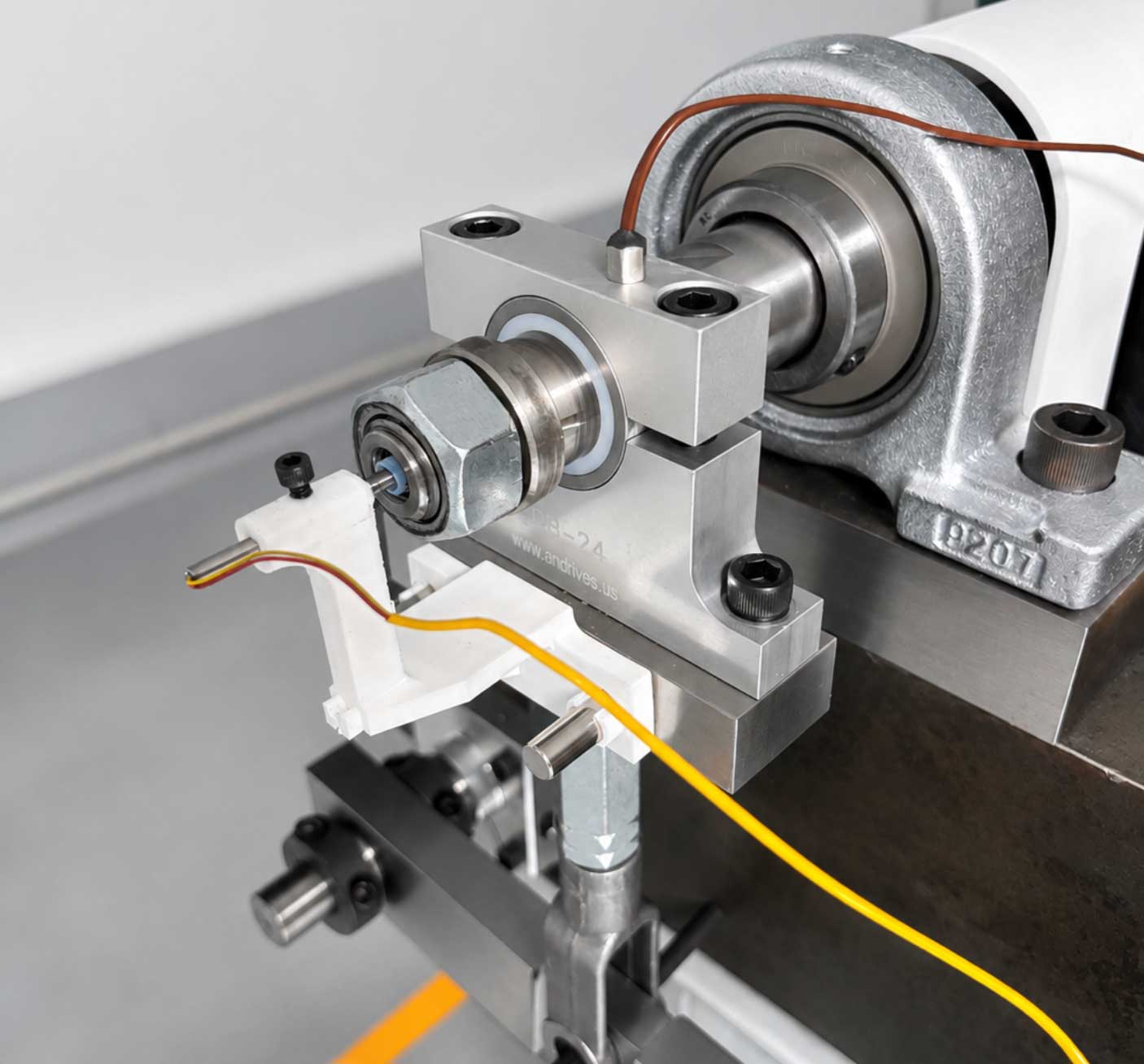
This experiment compared five materials under identical conditions. A bushing with an inside diameter of 25.4 mm (1″) and height of 19.05 mm (0.750″) was subjected to a radial load of 355.9 N (80 lbs.) at a shaft speed of 108 rpm, producing a PV value of 0.101 MPa·m/s (2,873 psi·ft/min). Interface temperature (CH1) was logged at one-minute intervals; housing temperature (CH2) was logged as a reference baseline. Each sample ran until it either stabilized at a steady plateau (pass) or until the interface temperature climbed exponentially out of control (fail).
Results
Key Finding
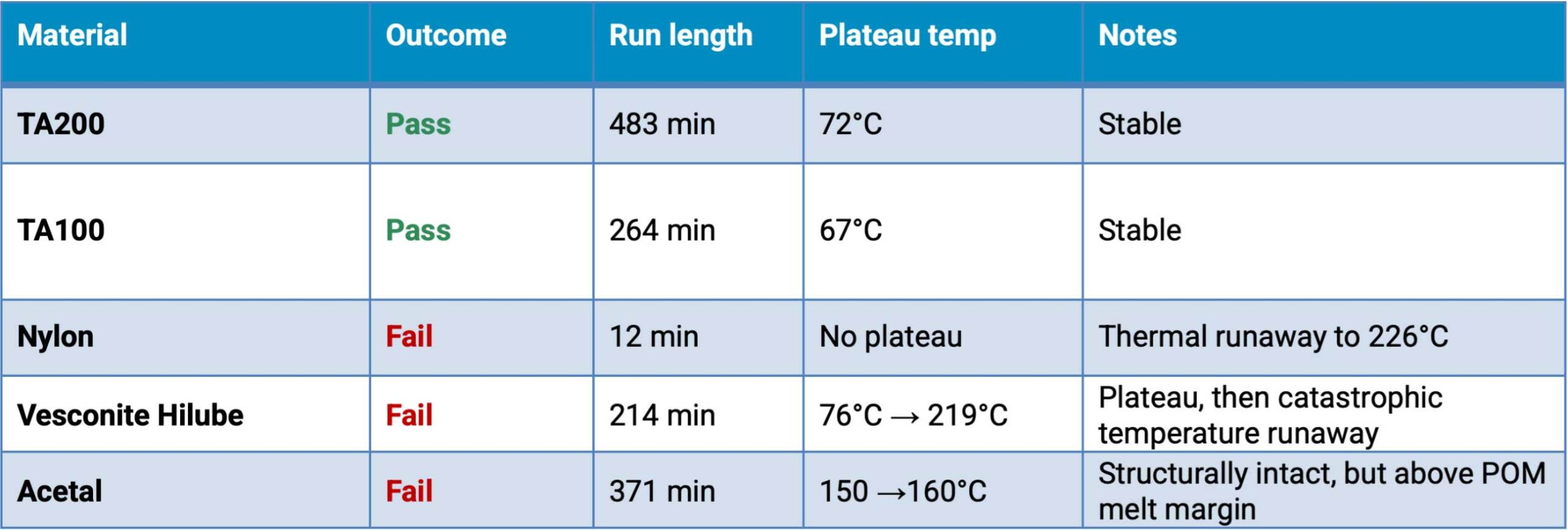
Both Tribotech TA100 and TA200 reached stable thermal equilibrium and ran without failure for the full test duration. TA200 ran the longest at 483 minutes.
Interface temperature over time
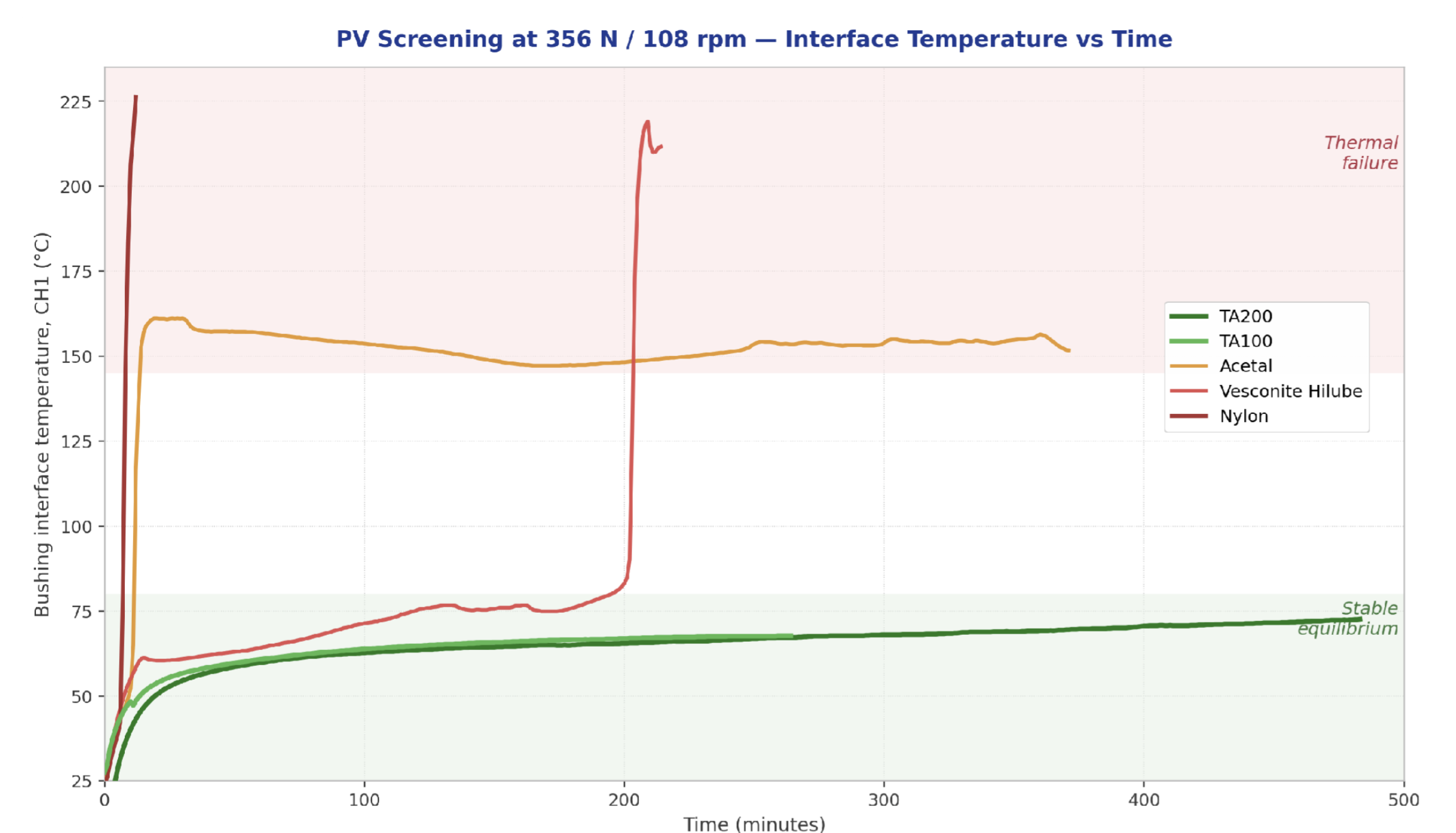
Bushing interface temperature (CH1) versus elapsed time for all five materials. Materials in the green band reached stable equilibrium; materials reaching the red band failed.
Analysis
Two materials achieved thermal equilibrium. TA100 and TA200 both stabilized at sub-75°C plateau temperatures and held them for hours. The test was terminated after 500 minutes.
Three materials failed to find a safe equilibrium.
Nylon went into immediate thermal runaway, reaching 226°C in 12 minutes. Nylon’s low thermal conductivity and moisture sensitivity make it a poor dry-running bushing. This known limitation is confirmed here in our lab.
Vesconite Hilube plateaued at 76°C for over three hours and looked like a pass for most of the test. Then at the 200-minute mark, the interface temperature spiked vertically, reaching 219°C in approximately four minutes. This is the signature of a lubricant-film breakdown at the PV limit in which a material holds temperature at its limit before abrupt failure. For equipment operating near a material’s PV ceiling, this event can take out of service unexpectedly.
Acetal remained intact but ran well above its safe operating range. Acetal raced to a plateau of 150–160°C within minutes and held it for the duration of the test. Although the bushing endured, the high run temperature makes the material unsustainable for long-term use.
Conclusion
At 80lbs / 108 rpm, Tribotech TA100 and TA200 both demonstrated exceptional stability in high temperatures over long periods. Where dry-running bushings must hold equilibrium under sustained load and rotational duty, Tribotech composite grades deliver predictable, stable behavior under extreme thermal conditions.
LEARN MORE | REQUEST A CUSTOM TEST
We run PV screenings regularly on our own materials and on customer-supplied samples to validate material selection before parts go into service. Contact us to discuss material selection for your application, or to submit a sample of your current bushing material for comparative testing.